What Hunome is — in plain language

The collective sensemaking operating system, with AI that works on the right data.

Hunome gives businesses, organisations and groups and networks a structured way to build shared understanding around a complex theme — by enabling contributors to add, connect, and characterise their perspectives in a visual, evolving map.

Hunome platform overview — SparkMap and The Lens

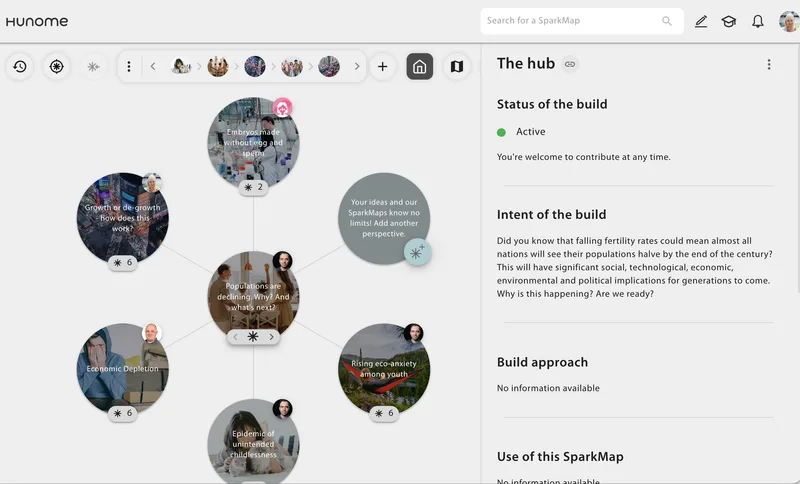
The core unit is a SparkMap — a living deliberation built around a theme. Contributors add individual Sparks: their perspective, experience, research, or analysis. Each Spark can be connected to others with a SparkOn relationship — building a map of how ideas relate.

Contributors also characterise their Sparks with Ignites — a layer of structured context. Unlike free-text discussion tools, every Spark carries structured, contributor-supplied metadata — argument type, worldview context, stakeholder relevance — so the AI reads declared structure rather than inferring intent from prose. That is what gives our AI something meaningful to work on.

The Lens, Hunome's analysis of the SparkMap as it evolves, reads the characterised deliberation in real time, finding patterns, surfacing connections and producing insights grounded in the deliberative intelligence your own people build. Nothing generic, and nothing interpolated from the internet: it is built from what your people understand.

The deliberation on Hunome produces deliberative intelligence: what your people work out together, read through the analysis and the AI that Hunome runs on it. Where collective sensemaking is the process, deliberative intelligence is the result.

Most tools that rank for collective sensemaking platforms ask people separately: surveys, narrative capture, voting, whiteboards. Hunome is built for making sense together. Five tests tell a real collective sensemaking platform apart.

The Category

What is collective sensemaking, and why it is different from collaboration

Collaboration produces outputs. Collective sensemaking produces understanding. The difference is not a matter of degree. It is a matter of what you are trying to build.

Read the perspective →

What Hunome is not

Hunome is the operating system for deliberative intelligence. The tools people compare it with do different jobs.

Not a survey tool.

A survey asks people separately and averages what they say. On Hunome, perspectives are brought into contact, so understanding forms between people.

Not a polling or opinion-mapping tool.

Polling counts positions. Opinion-mapping tools group people by how they vote on short statements. Hunome works with what people say and why, in contributions that are connected, characterised and kept with their reasoning.

Not a collaboration tool.

Collaboration tools coordinate work. Hunome builds understanding that did not exist before the group thought together.

Not a knowledge management system.

A knowledge system stores and retrieves what is already known. Hunome builds what is not yet known.

Not an AI assistant.

The AI works on what your people build, and never in place of them.

Not a workshop that ends.

A workshop closes. A SparkMap keeps developing, and a sync session on Hunome feeds the same map.

Not deliberative AI.

In AI engineering, a deliberative agent plans over an internal model of its environment. Hunome means the human work of deliberation, and what that work produces.

AI capabilities

Why Hunome's AI works on data generic enterprise AI can't reach.

The difference is not processing power. It is the quality and specificity of the data the AI is working on.

The Lens — real-time AI analysis

As contributors build a SparkMap, The Lens reads the characterised deliberation and surfaces emergent patterns — clusters of meaning, insights across threads, and gaps in understanding. Synthesis that is slow and labour-intensive to assemble by hand becomes visible as the deliberation builds. This is AI working on the right data: context-rich, typed, and evidenced by your own people.

AI that runs on data generic tools can't reach

Generic enterprise AI — Copilot, internal LLMs, any model running on public or corporate document stores — can only analyse what has already been documented. The Lens analyses what is being built right now, by the people who hold the knowledge that matters. The inputs are first-party to your organisation and exist in no document store, so a model trained on public or corporate documents has no equivalent data to run on.

Characterised data as AI substrate

Every Spark contributed to a SparkMap carries structured metadata through Ignites: argument quality, worldview context, relevance to specific stakeholders. This characterisation is what makes AI analysis meaningful rather than approximate. The Lens reads what was said and from where it was said — producing analysis and outputs that help you navigate the deliberation and surface insights otherwise difficult to see.

From deliberation to deliberative intelligence

Hunome translates AI-analysed collective understanding into structured output: decision seeds, impact seeds, and characterised views of where the organisation converges and where it is ready to act. Not a summary of what was said. A model of what was understood — grounded in the people who built it.

Platform features

Built for the architecture that genuine collective sensemaking requires.

SparkMaps

SparkMaps

Living deliberations built around a theme. Contributors add and connect perspectives over time. Unlike a document or deck fixed at publication, SparkMaps persist and keep evolving as contributors add and connect perspectives — so the understanding stays current.

Sparks & SparkOns

Sparks & SparkOns

Individual contributions — perspectives, research, analysis, experience — connected by typed relationships. The map of how ideas relate is as important as the ideas themselves.

Ignite characterisation

Ignite characterisation

Structured metadata on every contribution: argument quality, worldview context, relevance to specific stakeholders. The substrate that makes AI analysis meaningful.

The Lens (AI analysis)

The Lens (AI analysis)

Real-time AI analysis of the characterised deliberation. Clusters, tensions, gaps, and emerging insights — surfaced as the deliberation builds, not weeks after it ends.

SparkOrbits

SparkOrbits

Nested deliberations that connect across themes — building understanding that spans contexts, across subthemes, and compounds across time.

Deliberative intelligence

Deliberative intelligence

Structured output for decision-making: decision seeds, impact seeds, convergence maps. The collective understanding, in a form leadership can act on.

Product tiers

What sets you apart, and where you stand together, emerges from deliberation. Each tier takes it further.

On every tier people do the same thing: add their perspectives as Sparks, build on each other's with SparkOns, and say what each means with Ignites. Together that makes a SparkMap, a living map of how a group is thinking. What grows from tier to tier is where the SparkMap lives, who you can bring in, how it is led, and what you can read and share from it.

Words you will meet

SparkMapA living deliberation on a theme. One place where the thinking builds and stays.
SparkOne perspective, added by one contributor.
SparkOnA Spark that builds on another, so you see how the thinking connects.
IgniteHow a Spark is characterised, by its author and by others. It says what the Spark means.
The LensThe live read of the SparkMap, beside it as it builds.
SparkOutA page that shares a Spark of yours that others built on.
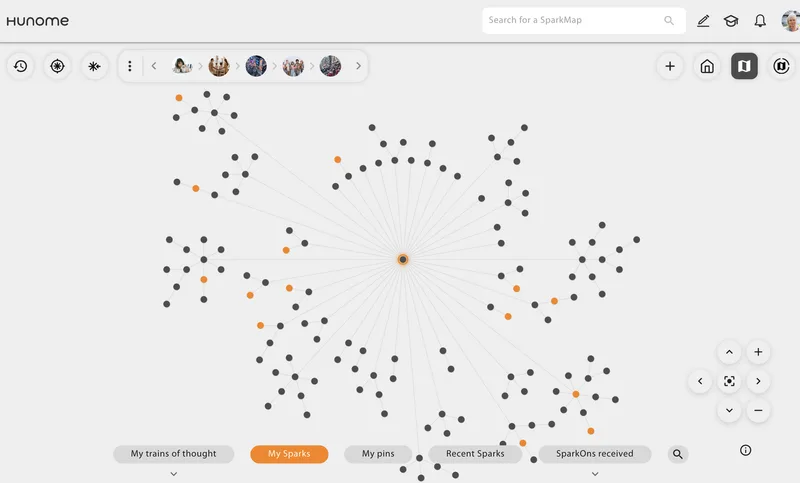
A SparkMap on Hunome: Sparks connected in a network view

Free Forever

Think together in the open

Why in the open. A theme worked through in the open reaches people you would not have known to invite, and what is built stays visible for others to build on.

For whom. People and groups with a theme that gains from many perspectives, and anyone who wants to see how thinking together on Hunome works.

Where it lives

In the open. Every member of Hunome can see a SparkMap and contribute to it. Unlimited SparkMaps.

Who you bring in

Any member can join. Each member can invite 5 people a month.

How it is led

Whoever starts the SparkMap leads it, and says what it is for on its front page (The HubThe SparkMap's front page: what it is for, how it runs and who leads it.).

What you read and share

See how the thinking connects and where it gathers (The LensThe live read of the SparkMap, beside it as it builds.: network view, Trains of ThoughtA path through Sparks that someone saved and shared., insights). Share a Spark of yours that others built on (SparkOutA page that shares a Spark of yours that others built on.).

The Hub of a SparkMap, where the Lead sets the scene

Starter

Lead a SparkMap in the open

Why lead in the open. Groups and networks gain from being seen. An open SparkMap shows what the group is working on, brings in new contributors and gives its members something to point to. Starter adds the means to lead that well.

For whom. Associations, networks, communities of practice and movements, and any Lead whose theme needs reach more than privacy.

Where it lives

Still in the open, now with your own account. Three SparkMaps with the Lead tools; your others carry on in Free Forever.

Who you bring in

200 invitations a year, sent in bulk or gradually, with reminders. A Co-Lead shares the leading.

How it is led

Tell contributors what the SparkMap is for and how it will run (Setting the scene, on The HubThe Lead's words on The Hub: what the SparkMap is for and how it will run.). Plan sync sessions and async milestones. Open a call for the contributors you need (Call to build pageA page that invites the contributors a SparkMap needs.). Nudge, and ask for feedback.

What you read and share

More ways to characterise a Spark and more Lens reads (fuller Ignite sets, more of The LensMore Ignites to characterise with, and more Lens reads from them.). Share what the deliberation produced, as a page you compose (SparkMap SparkOutA page the Lead composes to share what the deliberation produced.).

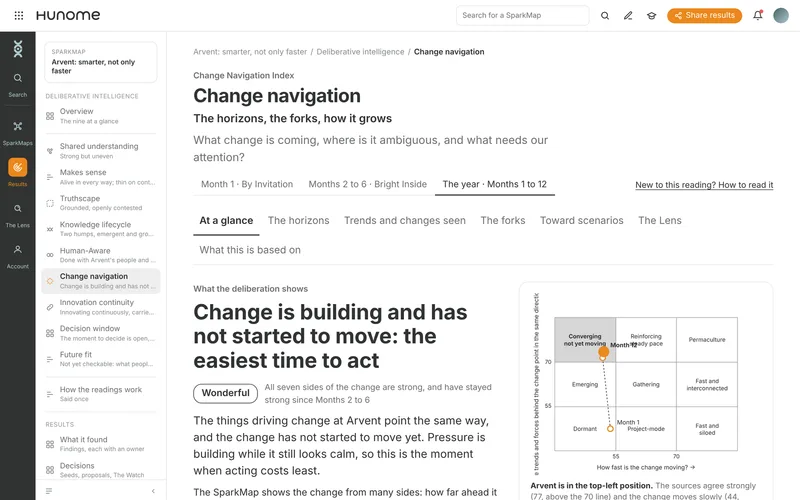
A deliberative intelligence reading on Hunome

Premium

Your organisation's own space, from deliberation to decisions

Why your own space. Some thinking has to happen among your own people, and the outsiders you choose, before it is ready for anyone else: a strategy, a transformation, a change still taking shape. You choose, SparkMap by SparkMap, how open it is. A SparkMap can still be published to the open when that serves you.

For whom. Large enterprises and organisations whose decisions affect many people, and whoever leads and decides in them.

Where these are delivered:AlignmentReadinessTraceabilityDifferentiationGoverning

Where it lives

In your organisation's own space. You choose how open each SparkMap is, from all your people to an invitee list, with Chatham House rules where the theme calls for it (culture modesHow open a SparkMap is, chosen SparkMap by SparkMap.). Up to 100 SparkMaps, linked within the account.

Who you bring in

Your whole organisation, and the partners, customers and experts around it, as you need to.

How it is led

Give each SparkMap its purpose, from a light direction to a large programme (DirectionsLighter goals, for groups not running a large programme. and goalsWhat the deliberation is for: strategy, transformation, change, innovation, vision.). Guide the thinking toward it (deliberation framesA guide for the thinking. It helps people think toward the goal and leaves every other input welcome., such as trend analysis and risk analysis). A Business Owner runs the programme with SparkMap Leads.

Where AI comes in

Your key documents and AI outputs become part of the deliberation, so people settle together what they mean (ResourcesThe place on The Hub for your organisation's documents, reports and AI outputs, matched to the Sparks they bear on., on The Hub). AI finds the patterns and the gaps across the SparkMap. It is there to make sense of what makes sense.

What you read and share

The level and quality of understanding between people, who thinks in which direction and why, what resonates with the people affected (deliberative intelligenceDeliberative intelligence is what deliberation produces: shared understanding that holds, held as a living structure of how a group is thinking, with the reasoning behind it preserved and available to be worked with later. Where collective sensemaking is the process, deliberative intelligence is the result.). What is ready to decide, and when (Decision IntelligenceWhere what is ready to decide is put in front of those who lead and decide.). What was decided and why, told to contributors and the organisation (Decision OutreachA composed page that tells what was decided, why, and which Sparks led to it.). Every reading leads back to the Sparks behind it.

With it

Dedicated onboarding, SSO and integrations, enterprise SLA and DPA.

Early clients join as Anchor clients

Talk to us

The three at a glance

Free ForeverStarterPremium
Where the SparkMap livesIn the open, with every member of HunomeIn the open, with your own accountIn your organisation's own space, as open as you choose
Who you bring in5 invitations a month for each member200 invitations a year, sent in bulk or graduallyYour whole organisation, and invited people outside it, as you need to
How it is ledBy whoever starts itBy a Lead and a Co-Lead, with the Lead toolsBy a Business Owner and SparkMap Leads, with Directions, goals and deliberation frames
What you read and shareThe Lens, and your own Spark as a SparkOutMore Lens reads, and a SparkMap SparkOutDeliberative intelligence, Decision Intelligence and Decision Outreach

The understanding your organisation needs is waiting to be built, and your AI investment will work harder when it has it.