
Customer stories & testimonials
How people make sense together with Hunome
Hunome helps groups, organisations, and communities move beyond surveys, workshops, and expert panels — to a shared, structured map of how people are thinking, and where deliberative intelligence is ready to act. These are their stories.

Enterprise & organisations
Why leaders are saying yes
Early adopters from technology, strategy and healthcare sectors on what Hunome makes possible for their teams.
"Hunome feels like a great product. We see we could use Hunome in 3 areas."
CEO + CISO, Global security SaaS company
"We have nothing today that can do what Hunome promises — to show alignment and misalignment in real time. If this works, it changes how we run transformation."
Senior Executive, Multinational Industrial Company
"Hunome makes perfect sense and suits us perfectly. We tested it, it worked great. Hunome is well suited for strategy work, enabling hidden needs and new opportunities to surface. Instead of traditional surveys, it provides deep understanding and actionable insights. AI is a clear trump card."
CEO, Strategy Consulting Firm
"I can see where we have a gap. For management to be ready to move forward and invest in a new idea, the idea must be well thought out from all perspectives and receive confirmation."
CEO, Nordic Distributor of Pharmaceuticals and Health Products
Featured case studies
What Hunome reveals that no other tool can
Structured stories from practitioners who ran deliberations on Hunome, and what they found.
Adam Sharpe
Director of Learning, Futurely Founder & Project Lead, People Power Game

Why Hunome
Hunome's sensemaking architecture allows contributors to build on each other's thinking rather than simply respond to researcher-defined categories. Clusters emerge from the ground up — not coded by a researcher, not assigned by a facilitator.

Context / Problem
Futurely convened a global community to deliberate on population decline: why birth rates are falling and what comes next. Standard research methods — surveys, expert panels, focus groups — would have pre-shaped the answer. Futurely needed the intelligence to find its own form.

How they used it
A global community of contributors deliberated across an open SparkMap on population decline. Participants added Sparks, built ignite connections, and created trains of thought that built causally across each other's contributions.

7
Thematic clusters emerged without researcher coding

3+
Unforeseen cluster themes surfaced only through collective sensemaking

Multi-hop
trains of thought from macro to micro, contributor to contributor

Outcomes & findings
Seven thematic clusters emerged organically. Some were expected: social care crisis, economic pressures on family formation, rural depopulation. Others could not have been anticipated by any conventional instrument.
1. A cluster on the power dynamics of artificial wombs 2. A cluster on gene editing and demographic consequences 3. A thread on the epidemic of unintended childlessness — not infertility, but the quiet accumulation of life circumstances that meant children simply never happened
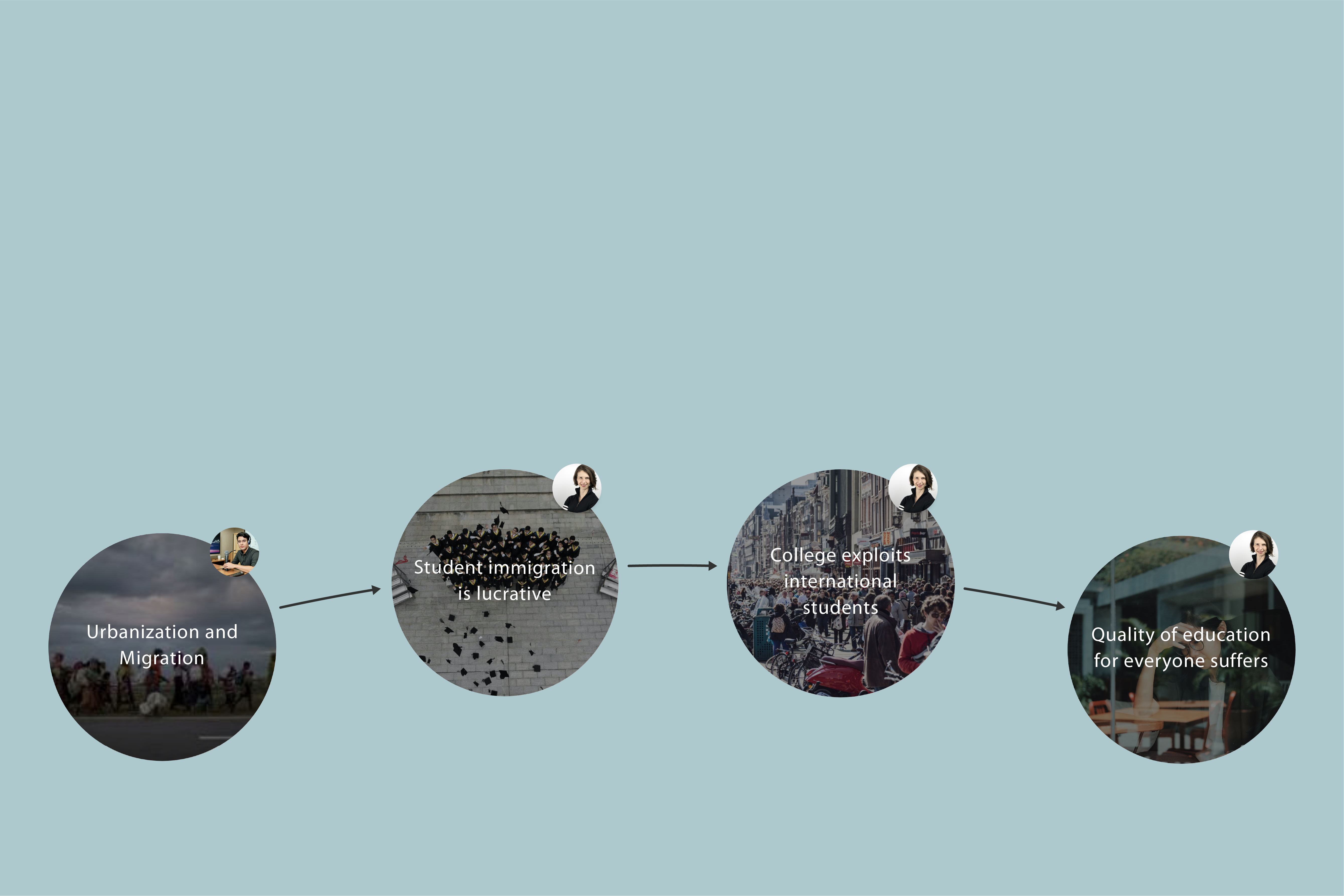
Train of thought
A causal chain from global demographic pressure to a classroom in Ontario, constructed step by step by contributors building on each other.

Adam Sharpe
"The synthesis and clustering showed us dynamics we had never seen before. It is a new way to understand societal change at scale."

Adam Sharpe
"The platform is intelligent, intuitive, and fun to use, and the team is passionate and mission-oriented. We love partnering with Hunome."
Timo Kuusiola
CEO & Program Lead Creatura Think & Do Tank

Why Hunome
Hunome's ignite system captures the character of each contribution — whether it is a question, an expert fact, a belief, a gut feel, or a value-judgement — not just its content. That signal, legible at corpus level, reveals what conventional synthesis tools cannot see.

Context / Problem
Creatura convened contributors to make sense of EU environmental and economic policy. Standard tools would have produced familiar output: ranked priorities, heat maps of concern, a synthesis of expert positions. What was needed was something structurally different — not a summary of what people think, but a map of how they are thinking, and where that thinking is stuck.

18x
Question was the most-used sensemaking signal — nearly 2× the next

11x
"Economic" appeared as an ignite in an environmental policy map

6+
distinct knowtypes captured, treating values as epistemically valid

Outcomes & findings
Three structural findings emerged that no conventional tool could have surfaced:
1. The dominant signal was uncertainty — Question appeared 18 times, nearly double the next category. In a domain saturated with white papers and technical roadmaps, the dominant epistemic signal from knowledgeable contributors was uncertainty. That is not a finding you can get from a survey. 2. Multiple ways of knowing were structurally necessary — Expert Fact and Research anchored institutional voices, but Gut Feel, Belief, and Values were epistemically distinct and equally necessary. 3. Tension between domains made visible — "Economic" appeared 11 times as an ignite across an environmental policy deliberation.

Timo Kuusiola
"Hunome enables us to make sense together in a way no other tool does."

Timo Kuusiola
"Hunome is a great product to discuss and deliberate on complex themes, to arrive with a group at a shared understanding of the multiple dimensions in it and the potential directions for solutions. We have tried many platforms before. Hunome is the one for sensemaking together."

Anastasia Siapka
FWO PhD Fellow & Professor of Organisational Behaviour at KU Leuven
Nicky Dries
Professor of Organizational Behavior at Future of Work Lab, KU Leuven

Context / Problem
The AI and Future of Work debate is dominated by a narrow set of voices — Silicon Valley technologists, economists, and a handful of public intellectuals. Nicky Dries's media analysis found that in Belgium's coverage of the topic, social scientists, humanists, and philosophers were almost entirely absent. The debate was being shaped without the people most qualified to think about its human dimensions. Citizens were passive recipients of other people's visions of the future.

Why Hunome
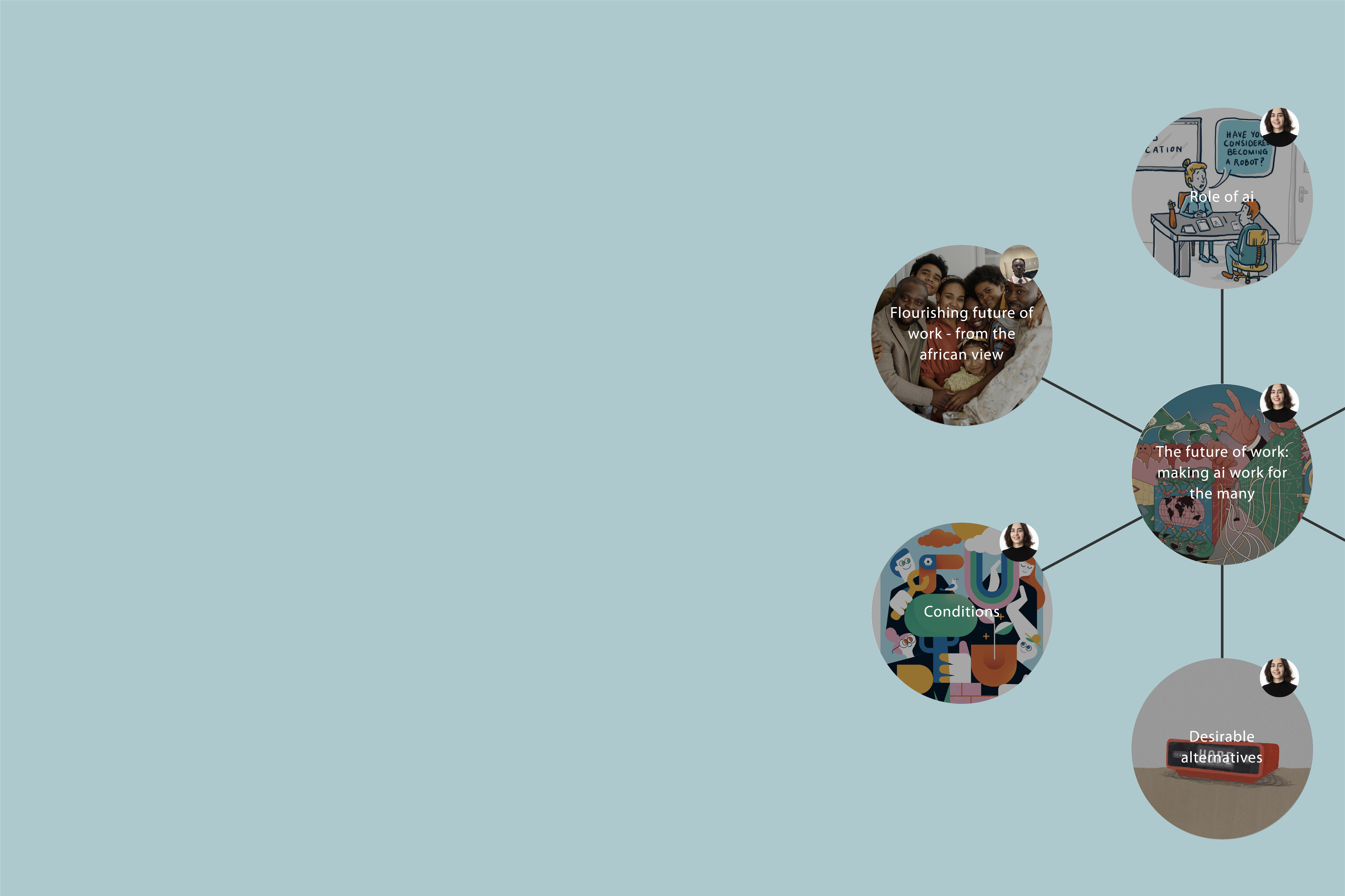
Hunome's SparkMap format enables structured collective imagination — not just opinions or survey responses, but the co-construction of alternative futures. It offered an online space where people with diverse disciplinary backgrounds could collectively practise imagination and build on each other's thinking about what AI at work could and should look like.

Anastasia Siapka
"Rather than passive recipients of other's acts of imagination, citizens should be co-producers of the narratives about AI and the Future of Work and of the relevant policy agendas. Our Hunome SparkMap supports this effort by offering an online space where we can collectively practise our imagination and co-create desirable scenarios for AI at work."
How they used it
The KU Leuven team ran a Hunome SparkMap as part of a deliberative research project on AI and the Future of Work — inviting contributors from sociology, philosophy, political science, economics, and policy backgrounds to co-create desirable scenarios, not just comment on existing ones.
Testimonials
In their own words
Practitioners, researchers, facilitators, and leaders on what Hunome made possible.
Now, more than ever, humans need to engage in a process that allows us to understand complex, ambiguous or confusing issues or events — a process by which we assign meaning to our collective experiences. That process is called sensemaking. Hunome has been developing a tool that allows us to capture the many facets of these experiences. And not just that, but to also link them up, to generate new insights and reflect on others. It is important for many reasons, but most notably to help with problem-solving, to facilitate decision-making, to enhance learning or to improve communication. We cannot afford not to do it. It's our collective responsibility to finally make sense of the world.
Building shared understanding on Universal Basic IncomeDóra Hietavirta
I love it! Sounds fantastic — congratulations for building something like this! In cancer research, scientists are very specialised — narrow aspects, no one looking at interactions between things, one's work is the centre of the universe. But there are many other views and experiences — technical, energy, and many other points of view. There is a need to make all these visible. I have been trying to find a way to tell this story. I've tried systems tools and Miro, but Hunome does this in a way nothing else does.
Advisor, Human Health Education and Research FoundationHouda Boulahbal
While billions are spent on studying the genome, the human dimension developed by Hunome is just as important, if not more so. It's a gateway to human security.

We've experienced the power of the new emerging social platform Hunome for our continuous exploration into the wonderful world of curiosity. The already broad definition of curiosity has gained so many new insights.
Hunome is a great tool also for conference events — to engage participants and to keep the content and discussions alive even after the event. You can activate people to vocalise their viewpoints instead of just listening to a presenter.

Hunome helps us align diverse voices around systemic change. Hunome offers our members a platform where complex societal questions can be explored collaboratively — making invisible connections visible and empowering collective action.
Facilitator, UBI Lab Network FinlandMarkus Vähälä
See what collective sensemaking can produce for your organisation.