
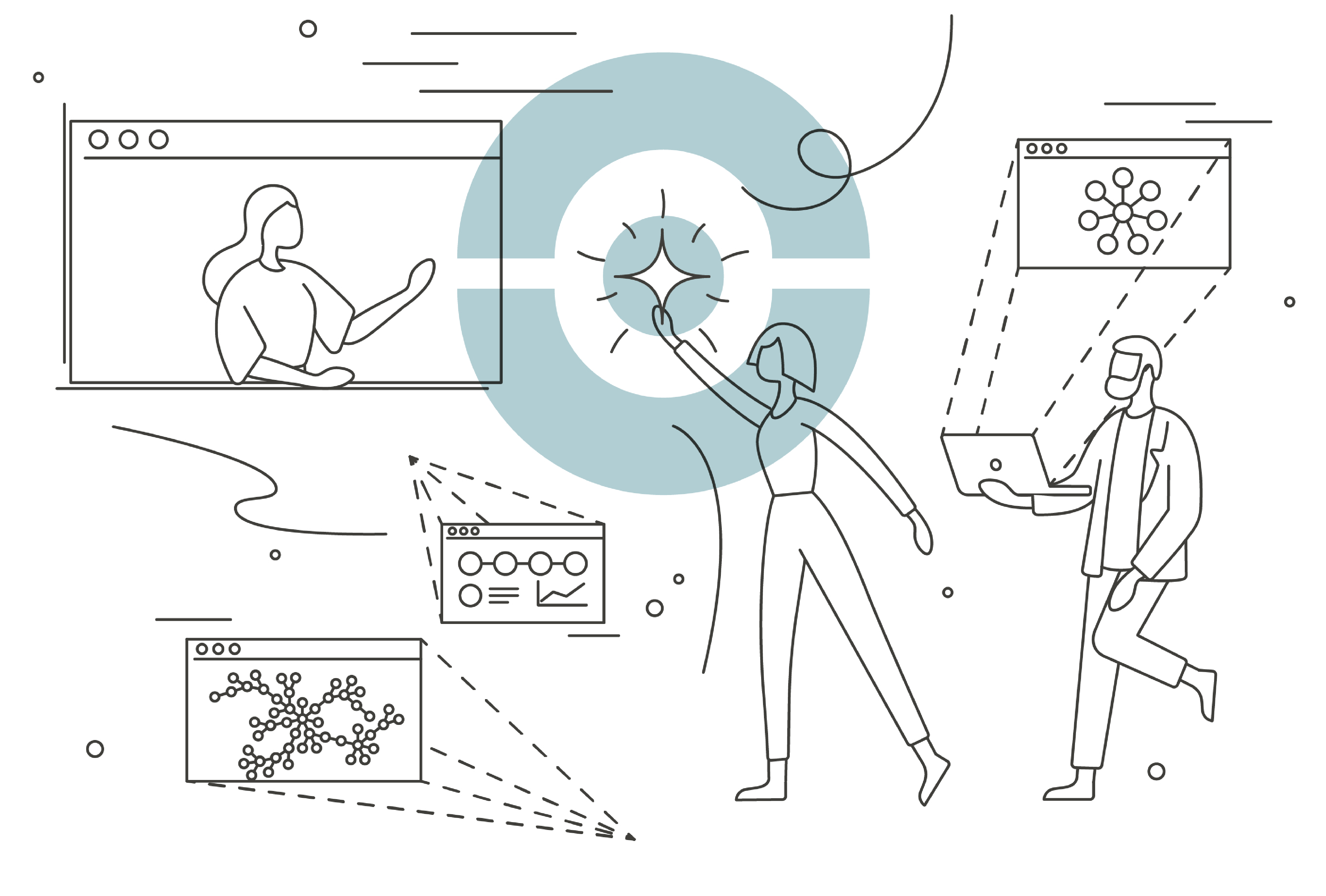
Karl Weick, the organisational theorist who gave sensemaking its current meaning, described it in 2005 as 'the ongoing retrospective development of plausible images that rationalize what people are doing' (Weick, Sutcliffe and Obstfeld, Organization Science, 2005). That definition is accurate and important. What it does not yet describe is what happens when the process is structured, characterised and made persistent: when it becomes an operating system rather than an occasional event. That is what Hunome is built for.
The word doing the work is collective. You cannot make sense of something together by asking people separately, which is why most collective sensemaking platforms in the search results are not. What to look for instead.
What makes it different from collaboration
Collaboration tools coordinate people working toward a shared goal. A Slack channel captures what people were willing to say on a particular day. A shared document captures positions at a moment in time. Neither produces a map of what the group collectively understands: where their reasoning converges, which voices are missing, what the tensions are.
Collaboration produces outputs. Collective sensemaking produces the understanding that makes outputs worth having.
Three things distinguish collective sensemaking from collaboration, discussion or knowledge management:
Characterised contributions
Every perspective carries its characterisation: the knowtype behind it, the worldview it comes from, how it relates to what others have said, and what it signals. You know not just what people think but from where they are thinking. This is what places Hunome in a different category from collaboration, discussion and knowledge-management tools, and what makes its outputs a substrate for analysis.
Connected reasoning
Contributors map each perspective against the others: where it builds on, challenges or reframes what is already there. The connections between ideas are as informative as the ideas themselves. A map of how ideas relate is categorically more useful than a list of what ideas exist.
Living understanding
The map grows as understanding develops. A SparkMap does not expire when a session ends or freeze into a document. Signals that are anecdotal or emergent in month one can be followed as they form, ground and settle: becoming established understanding, generating new questions or being superseded by what the collective learns. This is the knowledge lifecycle organisations build when collective sensemaking runs continuously.
What it is built to produce
In 2024, Hunome and Futurely ran a global deliberation on demographic change with 36 contributors from multiple continents. 7 clusters emerged, none pre-specified. Artificial wombs and their implications for power and wealth. Youth dating and financial stability in an AI-integrated world. The relationship between economic depletion and family formation. These were not topics anyone planned for. They surfaced because the structure let people with different ways of knowing build on each other, and never compressed them toward a conclusion someone had chosen in advance.
The 7 clusters were not in anyone's brief, and no existing method would have found them. It is a different category of output.
Why now
AI is taking over the processing of knowledge that has already been expressed. That raises the value of the understanding that has not: the tacit, contextual, evolving knowledge held in people's heads and beyond the organisation's walls. And of the understanding that does not exist yet anywhere, because it is only made when those people think together. Organisations that invest in collective sensemaking are building the human understanding that makes every other investment work harder.
The world thinks beyond your walls. Collective sensemaking is how you think with it.