
Deliberate beyond current data.Decide what holds.
Differentiate with novel thinking: what your people work out together, which no model can reach because nobody has written it down yet.
Hunome gives organisations a way to deliberate collectively and build the deliberative intelligence their decisions rest on: what their people work out together, held in a form they can act on.
AI that works on the right data
Generic AI summarises what already exists. Hunome puts AI to work on what your people are building together.
Enterprise AI tools are only as good as the data they run on. They process documents, past decisions and public knowledge. They cannot reach the undocumented, evolving understanding your people hold, and they cannot produce the understanding that only exists once those people think together. Hunome builds that understanding through structured deliberation, then applies AI to surface patterns, connections and signals that are slow and labour-intensive to assemble by hand across hundreds of interconnected contributions.
Strategy · Change · Innovation
Running an enterprise?
The perspectives that matter to your next decision are distributed across your organisation and ecosystem. Hunome builds the collective understanding your AI tools cannot, then uses AI to make it actionable.
See how it works for enterprise →Policy · Advocacy · Research
Leading a societal initiative?
Your case has to be visibly built with the people it affects, not just argued well in front of them. Hunome builds it, and surfaces the patterns through AI analysis.
See how it works for your organisation →Networks · Communities · Researchers
Building with a group?
Start free. Bring your people around a theme that matters. Build understanding none of you arrived with, and see where it converges and where the real gaps are.
Start building free →The failure no one names
Your decisions are only as good as the understanding behind them.
Every tool in your current stack (surveys, workshops, AI summaries, strategy decks) was designed to aggregate and converge. To take diverse input and produce a single output.
That design is the problem. Because the process of aggregating and converging destroys exactly what makes understanding actionable: the reasoning, the texture, the connections between perspectives that no single mind holds.
The failure is not visible in the output. It looks like a decision. It behaves like a guess.
Why existing tools cannot close this gap
These tools do the job they were built for. Building shared understanding is not that job.
Generic AI tools
Work on existing documented knowledge. Synthesise what has already been expressed. Cannot access the contextual understanding your people hold. Applying AI to poor inputs produces confident-sounding wrong answers.
Surveys
Capture isolated responses at a point in time. Perspectives do not interact, build on each other or evolve. You get a distribution of outputs with no understanding of what produced them.
Workshops
Time-boxed, attendance-limited, dominated by the most vocal voices. The insight in the quiet person at the end of the table is the one that matters most, and the format structurally excludes it.
A different category of tool
Collective sensemaking builds what existing tools cannot.
Collective sensemaking is the process by which a group builds genuine shared understanding. Not agreement and not consensus: a living map of how understanding is forming, where it converges, where it is still contested, and where the gaps are.
It preserves the reasoning behind positions. It gives structural weight to every way of knowing (experiential, analytical, creative, philosophical) and records which one is behind each contribution. Hunome calls this the knowtype, the first of several ways a contribution is characterised: its stance, its time and context, what it says is missing, the future it points to. It holds not just what people think but from where they are thinking.
Collective sensemaking produces something existing tools are not built to produce: a living map of how understanding formed (the reasoning, the connections, the points of contention) rather than a single aggregated output. No organisation has had an operating system for this. That is what Hunome is.
What Hunome does
Hunome is the operating system for deliberative intelligence, with AI that works on the data that matters.
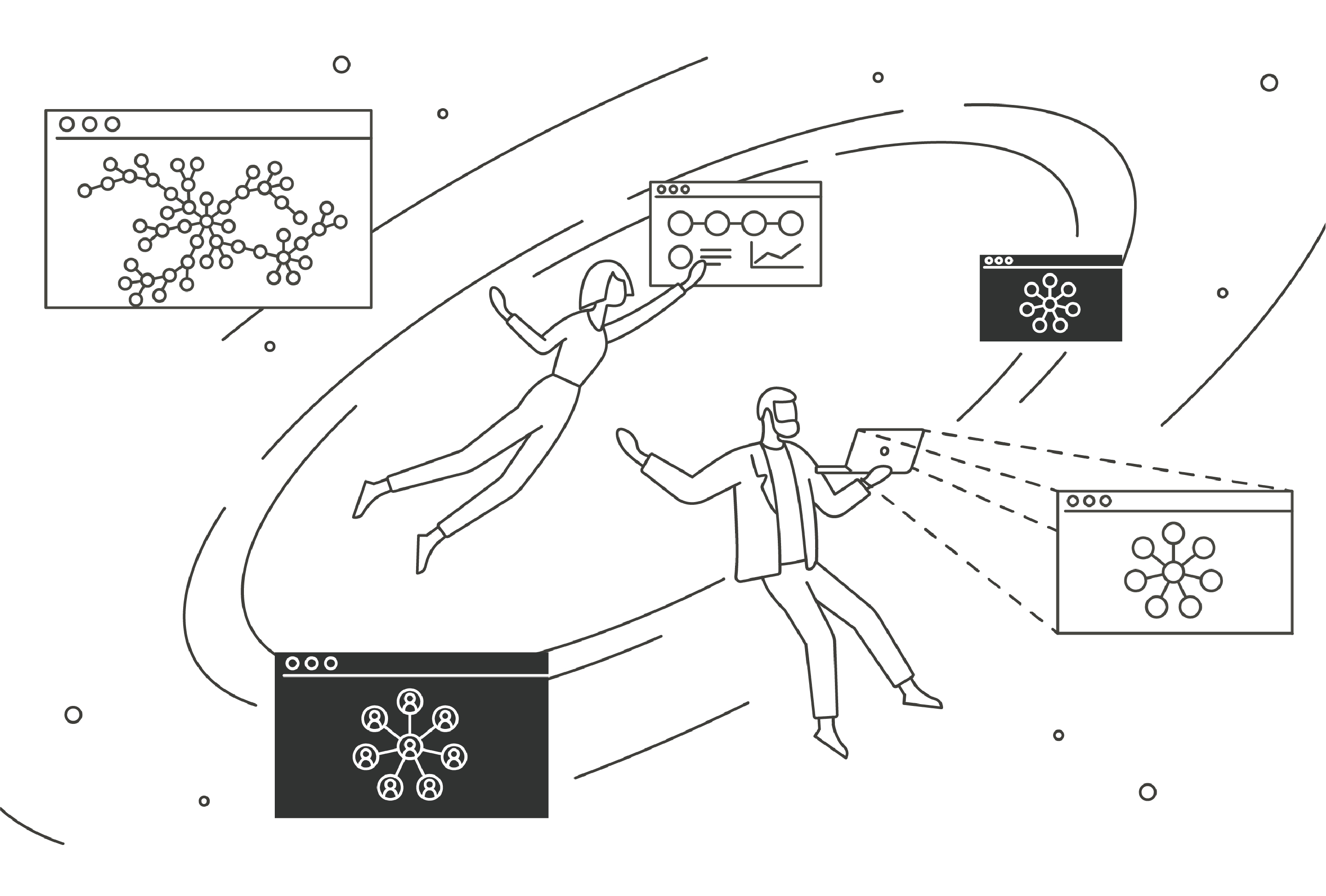
Contributors build living SparkMaps: structured visual deliberations where they add perspectives, connect them and characterise what each one is. The Lens, the analysis sidekick to the SparkMap, shows contributors and the person leading the deliberation where clusters of meaning, emerging tensions and insights are forming, while the deliberation is still building.
Deliberation produces deliberative intelligence: what your people work out together, read through the analysis and the AI that Hunome runs on it. It is a decision-oriented understanding of where the emergent thinking is gaining ground, where it resonates and why, and where it is ready to act.
The AI works on what your people build, and never in place of them. The output is a decision your organisation built, and therefore owns. That is what human-aware by design means: Hunome keeps who is thinking, and how they know what they know, attached to their contribution and available to the analysis, rather than averaged out of it.
What the category is built to produce
36 people. 7 emergent clusters. None pre-specified.
In 2024, Hunome and Futurely ran a global deliberation on demographic change. 36 contributors from multiple continents built a collective SparkMap over several months. What emerged was not predictable from any brief: artificial wombs alongside economic depletion alongside youth dating and financial stability in an AI-integrated world.
Surveys don't surface connections like these. Workshops don't hold them together long enough. AI summaries can't generate what people, thinking together with full context, can. Hunome's AI then made those connections visible and actionable at a glance.
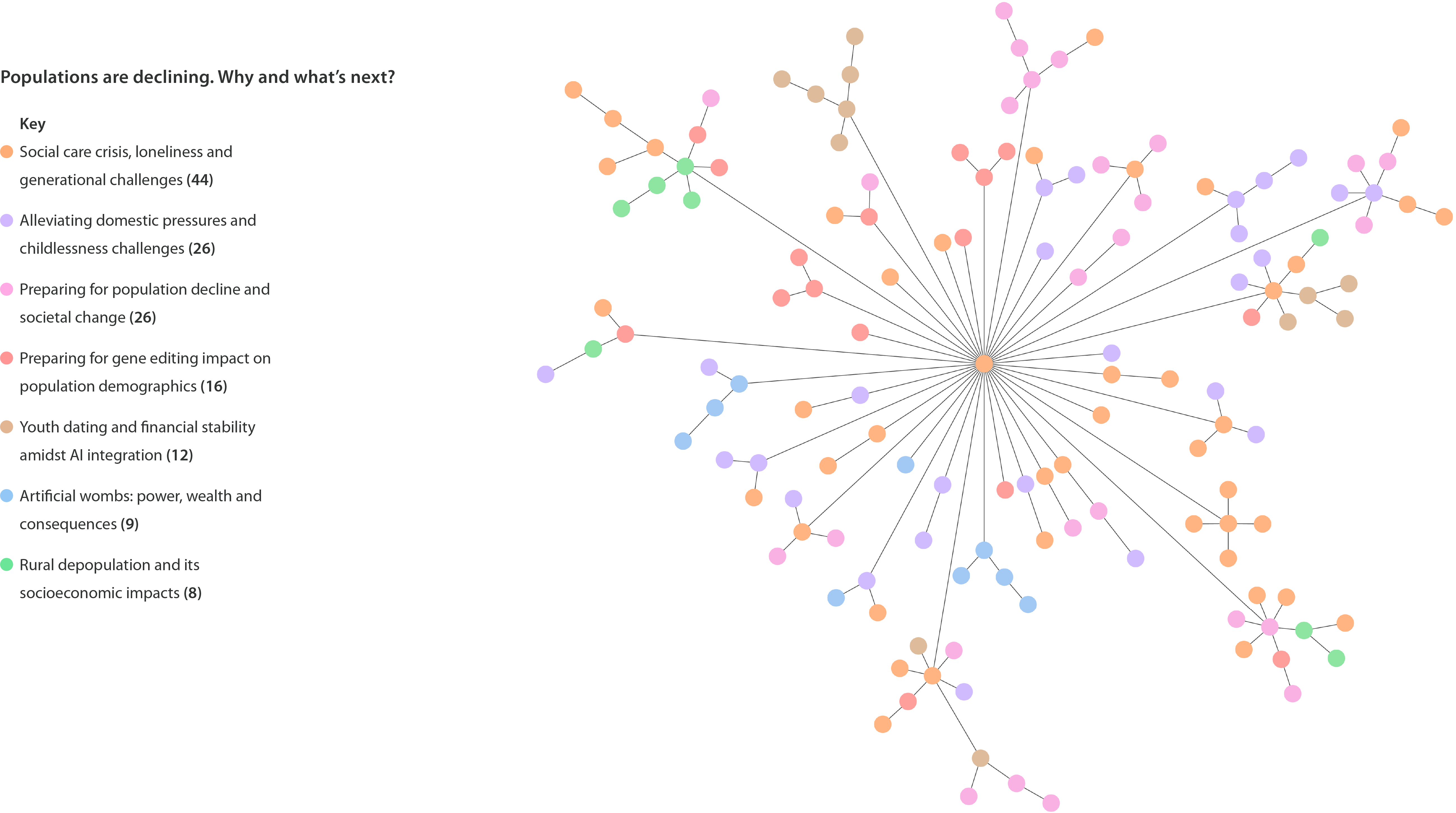
What 36 people from across the world understood together about demographic change: the understanding no research brief could have specified
A global deliberation. Seven emergent clusters. None pre-specified. This is what collective sensemaking produces that no other method can.
Read the perspective →of leaders feel underprepared for future disruptions
World Economic Forum & McKinsey
of companies are future-built, generating 3× shareholder returns
BCG
of CEOs say they need to rewrite their business playbook to win
IBM Global CEO Study
Capability isn't the gap. Understanding is.
The organisations that close this gap build a systematic way to know what their people and stakeholders collectively understand, and act on it. AI accelerates the analysis. It cannot substitute for the understanding itself.
Your organisation can think further together than any part of it can alone. Hunome is how that thinking gets built.